
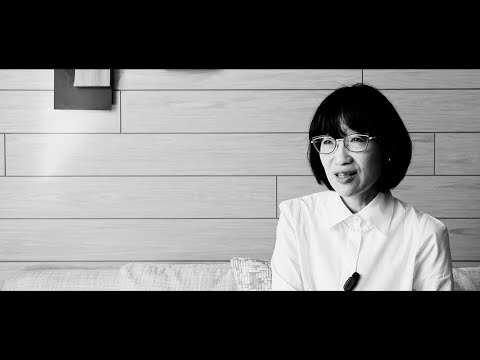

Ms. Mizuno, please tell us about the background and history of your current company's activities as an area manager.
Sure. Our company was originally founded in the 1960s, when Aoyama-dori Avenue was to be widened in anticipation of the 1964 Tokyo Olympics. Aoyama-dori, which had previously been 20 meters wide, needed to be widened to 40 meters to ease traffic congestion during the Olympics. So, the people who lived along the street, in other words, those who had businesses facing the street, had to be evicted.
However, if these people left the town, Aoyama itself would lose its vitality. At that time, many of the stores were both homes and businesses, and since they lived and did business together, they would lose the very foundation of their livelihoods. Under such circumstances, my uncle thought, "Is there any way we can stay in Aoyama?”
Just then, my uncle was working for the Japan Housing Corporation, now UR Urban Renaissance Agency, so I wondered if I could use my company's power to do something to help build the city. He wondered if he could protect the city in terms of hardware. So, after many discussions with the landowners who were being evicted, he decided to construct a new building by combining the eviction fees paid to the landowners and the land of the residents at the back of the building that would face the main street due to the widening of the street.
In that building, we tried to create a system that would allow us to continue to do business as before, and put the residential portion on top of it, so that we could live and work in the same building. To do this, we utilized the power of the company at the time to build four buildings.
We also considered how to operate the leasehold and leasehold landowners by creating a system called a landowner corporation. We incorporated a group of landowners with land lease rights, and the corporation became the owner of the building. Generally, land with leasehold interest and land with leasehold interest are owned separately, but here, the corporation is structured in a special way in which the members of the corporation are composed of landowners with leasehold interest, so that the leasehold owners own the building through the corporation.
Through this system, four buildings were constructed on Aoyama Dori. In terms of location, they are the building that used to be the Peacock building, the building that used to house Olympic (a sports store), the building that used to house Brooks Brothers, and the building that now houses Tenmaya (a curry bread shop).
However, since the first floor wasn’t attractive with only the landowner's stores, from the viewpoint of urban development, we also attracted the Daimaru Peacock, Tokyu Store, Daiichi Kangyo Bank (current Mizuho Bank), and others. The current company was established as a company that handles PM (property management) and BM (building management) of buildings while also handling leasing of commercial tenants. That is the company to which I now belong.
It has served PM and BM for 60 years, and in fact, metropolitan housing has been built on the back lot since then. Long ago, there was a school called Aoyama Commercial School, the predecessor of the current Tokyo Gakugei University, and after the war, barracks housing for repatriates were built, which later became metropolitan housing.
What was the impetus for the concept and what was your awareness of the issues in the current urban development of Aoyama?
Minato City was trying to create a "vision for community development," and I felt that Aoyama needed to act as soon as possible. So, with the cooperation of UR, we organized local issues and created a vision of what kind of town we wanted to create as Aoyama.
However, at that time, the issues that I raised with UR and others were, for example, "many illegally parked bicycles" and "narrow sidewalks.” I was sure that these issues existed, but I felt that they were not unique to Aoyama. Every town has such problems, and I thought, "This is not the reason why Aoyama has to be Aoyama.
Apart from general issues, did you have a "unique Aoyama" point of view?
That's right. Our president, Mr. Nakai, is a landowner in the area and also a doctor, but his way of thinking was completely different. He is a doctor, so he thinks of the town as if it were a human body.
A human body, is it?
Yes. He believes that "organ-specific medicine has its limits." For example, if a person's liver is bad, he will not only look at the liver, but if the circulation of qi, blood, and nerve flow are all regulated, the disease will naturally be cured. He says that the current state of the city is like this organ-specific medicine, and that "circulation" is not good.
I see. I guess it's like the buildings are so dense that you can't breathe.
That is exactly what happened. He said, "In the old days in Aoyama, when you were lying down, you could hear the train whistle and see Mt. Fuji. But now, buildings have been built, and the windows can’t be opened. He said that it was like being unable to breathe in the human body.
That is quite a fundamental thought.
That's right. He said, "We should build cities that suit the climate and climate of Japan." He said, "Green space should not be determined by the rate. First of all, we need greenery." He believed that buildings should not block the breath of air, and that both buildings and people should be in the cycle of nature.
Do you think this has influenced your current town planning?
Yes. Little by little, more and more developers and architectural experts began to share this idea. He used to say, "We should build buildings in the forest, not build outbuildings.
Are there any specific events that impressed you during the city planning process?
I remember a very memorable conversation I had with an old man at a 100-year-old liquor store that has been around for a long time. One day, when we talked about installing security cameras, the old man was extremely angry. He said, "I watch and protect the safety of this place where I have my store. For me, relying on security cameras is like “selling my soul.”.
So business and responsibility to the city are connected.
That's right. The people currently occupying the first floor of the building are tenants who pay rent, so they don't really feel a sense of responsibility toward the town. But I believe that in the future, both tenants and residents need to share responsibility for the town with everyone.
How are you now digesting Mr. Nakai's ideas in your own mind?
Of course, his ideas are firmly rooted in me as a philosophy. But I am not a doctor, and I don't have that much experience or ambition yet. However, I think I have to do both. I believe that it is important to both protect his ideas like a guardian and to feel a sense of reality as a person living in the city.
Specifically, how did you reflect Mr. Nakai's ideas in the actual urban development?
For example, the planning of green areas, building ventilation, and city layout are gradually moving toward realization.
So, you have taken the rather abstract philosophy and put it into reality.
Yes, I have. But it's not just about ideology. He also values the "interference zone" that existed in Japanese houses──the custom of taking off shoes and coats at the entrance, washing hands, etc. His theory is that cities need such buffer spaces as well.
This is an idea that we’d like to incorporate in contemporary urban design, isn’t it?
I think we should try to regain what was natural to us, such as the passage of wind, light, and closeness to nature.
So, is it your role to convey that to them?
That is what I believe. My role is to "translate" and convey Mr. Nakai's ideas. However, I am neither a doctor nor a scholar, so I am concerned not only with philosophical ideals, but also with how I can connect the real sensations and daily joys of the people who live and work in Aoyama.
Urban development requires a big vision, but I think it is rooted in the human connection of "making eye contact with someone and saying hello" and "having a conversation.
So, how do you connect your philosophy and ideas about the city with your practical work?
While talking with tenants and residents, we listen to what would make them happy and what they value. We carefully design opportunities for placemaking and communication so that people can feel that they are involved in the town.
You are bridging the gap between your "philosophy" and daily "activities", aren't you?
As an "insider" of the city of Aoyama, I’d like to continue to play a role in connecting us with people outside.